
Global Surge in Online Fraud: From ‘Scam Centers’ to Transnational Syndicates
At the UN Cybercrime Convention in Hanoi, Vietnam calls for stronger global cooperation to counter increasingly organized online fraud networks.

Thousands of scams, trillions Dong in losses
At a high-level dialogue on Global cooperation in responding to online fraud, held on the sidelines of the Signing Ceremony of the United Nations Convention Against Cybercrime, Senior Lieutenant General Pham The Tung, Deputy Minister of Public Security, warned that online fraud is becoming more organized and transnational than ever before.
“The world is entering a digital era where science and technology drive socio-economic development,” the Deputy Minister said said on October 25. “However, these advances also give rise to new forms of cybercrime, with online fraud becoming increasingly complex and causing enormous losses worldwide.”
Statistics from major economies reveal the global scale of the problem.
From 2020 to 2024, the FBI’s Internet Crime Complaint Center (IC3) received over 4.2 million complaints in the US, reporting losses exceeding $50.5 billion.
In China, authorities investigated nearly 2 million cases of telecom fraud over the same period, blocking billions of scam calls and messages and freezing assets worth over 151 billion USD.
Japan recorded 3,846 online fraud cases in 2023 alone, with losses totaling 45.5 billion yen (325 million USD), while Singapore logged more than 104,000 cases between 2022 and mid-2024, with losses nearing 1.7 billion USD.
Vietnam has also seen a sharp rise in cyber scams. The Ministry of Public Security detected more than 6,000 online fraud cases in 2024, with total damages exceeding 12 trillion VND (472 million USD). Authorities have prosecuted numerous suspects for using digital networks to appropriate assets or defraud victims.
“Fraudulent activity now occurs in almost every province,” Deputy Minister Tung noted. “These crimes are diverse in form, cross international borders, and employ increasingly sophisticated and professional techniques. We are seeing evidence of coordination and learning among global criminal gangs. Online scams are evolving into ‘fraud syndicates’ and ‘scam centers.’”
Most perpetrators, he added, operate from neighboring countries near Vietnam’s borders, posing serious challenges for investigation and prosecution.
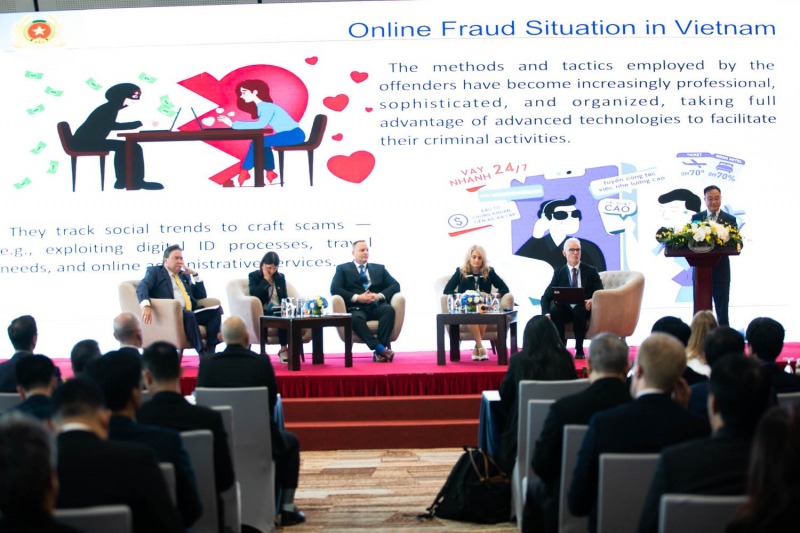
New tactics and sophisticated methods
Vietnamese authorities have identified four main categories of online fraud:
Impersonation Scams – Criminals pose as police officers, prosecutors, tax officials, or utility workers to trick victims into transferring money or installing fake apps that grant remote access to their devices.
Romance Scams – Fraudsters use fake online personas to build emotional trust, then lure victims into fake investment schemes or extort them using intimate photos or videos.
Investment Scams – Scammers create fake cryptocurrency, gold, or stock trading platforms, encouraging people to invest before crashing the site and stealing deposits.
Malware Distribution Scams – Hackers infiltrate company databases and impersonate foreign business partners to redirect payments to fraudulent accounts. Others create fake bank or e-commerce websites, using malware links to seize victims’ devices and assets.
“These scams exploit anonymity, cross-border reach, and new technologies,” Deputy Minister Tung explained. “Criminals also take advantage of current events and social trends to design realistic, convincing schemes that make detection difficult.”
Vietnam’s response: Technology, awareness, and partnerships
To combat online fraud, Vietnam’s Ministry of Public Security is pursuing a multi-layered strategy that combines law enforcement, public education, and international cooperation.
Domestically, authorities are fixing legal loopholes in cybersecurity and digital finance regulations, while expanding the use of advanced technologies such as artificial intelligence and big data for investigation and prevention.
The Ministry has also built data centers linking government agencies and strengthened the monitoring of high-tech crimes nationwide.
In 2024 alone, the Ministry coordinated with service providers to block over 8,000 fraudulent websites and accounts, many impersonating public agencies or fake recruitment programs. Public awareness efforts have included a “Handbook of Online Fraud Methods and Tactics”, over 750 million SMS warnings, and media campaigns on Google, Facebook, and TikTok featuring documentaries and short videos about cybercrime prevention.
“We’ve partnered with major platforms like Google and TikTok to launch anti-fraud awareness campaigns,” Deputy Minister Tung said. “We also established the Digital Trust Alliance, uniting tech companies, service providers, and online influencers to spread awareness and create a broad social impact.”
Cybercrime without borders
Vietnam’s Ministry of Public Security emphasizes that no nation can fight cybercrime alone. The country is strengthening cooperation with regional partners such as China, Thailand, Laos, Cambodia, and the Philippines to investigate and dismantle transnational scam networks.
Despite progress, he acknowledged that challenges remain global in nature — from jurisdictional barriers to technological complexity — requiring countries to share intelligence and coordinate investigations more effectively.
“Global cooperation, coordination, and joint action are essential,” he concluded. “Through dialogue and shared experience, we can develop practical solutions to prevent and combat cybercrime in all its forms — including online fraud — in the years ahead.”