
Government persists with high, substantive economic growth targets: PM
The Government leader acknowledged challenges, including weak domestic demand, slow real estate recovery, and pressure to achieve double-digit growth, emphasising that the Government will resolutely mobilise all resources for the target of double-digit growth this year.
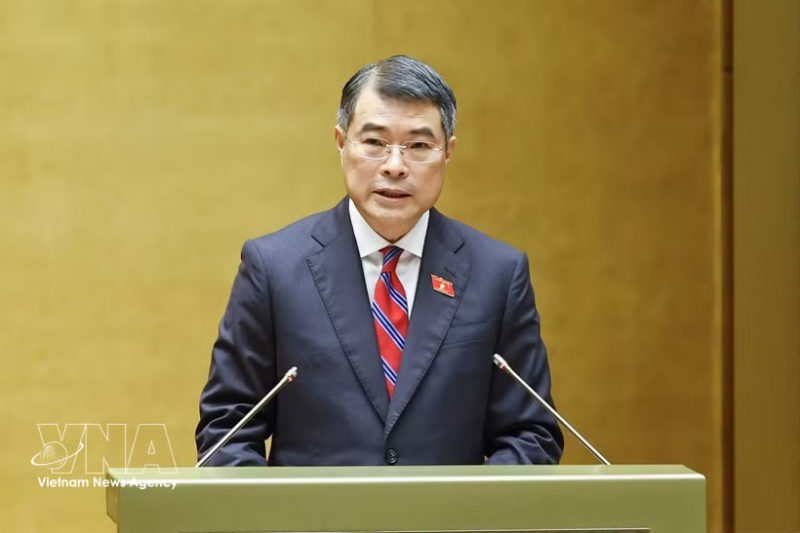
The Government is determined to pursue double-digit growth for 2026 under the principle of “right choices, swift implementation, thorough execution, measurable outcomes and clear accountability,” stated Prime Minister Le Minh Hung at the National Assembly’s first session on April 9.
Resolutely mobilising resources for growth
Delivering a supplementary report on the implementation of the socio-economic development and State budget plan in 2025 and performance in the early months of 2026, the PM said the country fulfilled and exceeded all 15 key socio-economic targets in 2025.
Macro-economic stability was maintained, GDP grew 8.02% - among the highest globally - raising the economy’s scale to 514 billion USD and ranking it 32nd worldwide. Inflation remained under control, while monetary markets and interest rates stayed broadly stable.
Total import–export turnover surpassed 930 billion USD, with rice exports reaching 8.1 million tonnes worth 4.1 billion USD, contributing to a trade surplus of over 20 billion USD. FDI inflows totalled 27.6 billion USD, international arrivals hit a record 21.2 million, and about 3,345 km of expressways were completed.
Social welfare outcomes were significant, including the early elimination of more than 334,000 temporary houses, construction of over 102,000 social housing units, and reduction of the multidimensional poverty rate to 1.3%. Vietnam’s e-government ranking rose 15 places compared to 2020, reaching 71st out of 193 countries.
National defence and security were strengthened, sovereignty safeguarded, and international integration advanced.
Despite global uncertainty, early 2026 saw continued positive momentum, with GDP estimated to grow 7.83%, CPI averaging 3.51%, first-quarter budget revenue reaching 829.4 trillion VND, equivalent to 31.5 billion USD (up 11.4%), FDI rising 9.1% to 5.4 billion USD, and trade turnover increasing 23% to 249.5 billion USD.
Vietnam also began construction of its first semiconductor chip manufacturing plant and accelerated Project 06 to expand digital public services.
The Government leader acknowledged challenges, including weak domestic demand, slow real estate recovery, and pressure to achieve double-digit growth, emphasising that the Government will resolutely mobilise all resources for the target of double-digit growth this year.
In 2026, the Government expects budget revenue to increase 10%, alongside strict spending cuts, including a 10% reduction in regular expenditure and an additional 5% cut by mid-year to prioritise development investment.
Public investment will be streamlined by cutting at least 30% of projects during 2026–2030, while administrative procedures and compliance costs will be reduced by 50%. The Government will also strive to cut at least 30% of conditional business lines and eliminate 100% of unnecessary business conditions.
The Government is prioritising the removal of bottlenecks in land and energy projects and ensuring electricity supply in all circumstances. Social targets include completing 108 inter-level schools in border communes by August 30, implementing electronic medical records nationwide, and improving grassroots-level cadres.
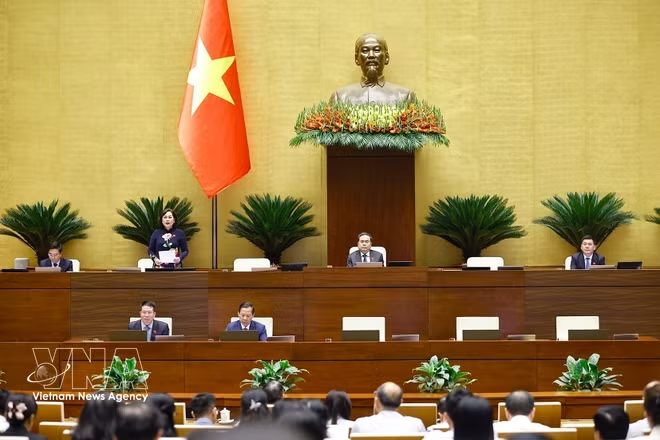
Realising breakthrough goals
Delivering a proposal on the socio-economic plan for the 2026-2030 period, Deputy PM Nguyen Van Thang said Vietnam achieved major results during 2021–2025, meeting or exceeding 22 out of 26 targets. GDP reached 517.4 billion USD in 2025, while GDP per capita rose 1.4 times compared to 2020 to 5,026 USD.
For 2026–2030, the Government proposed 59 key targets and 11 solution groups, and 92 tasks to be implemented immediately in 2026. It targets GDP growth of at least 10% in 2026 and on average over the five years, while maintaining macro-economic stability. By 2030, GDP per capita is projected to reach 8,500 USD (1.7 times that of 2025), with the digital economy accounting for around 30% of GDP.
Institutional reform remains the top priority, shifting governance from pre-approval to post-supervision and targeting a top-three ASEAN investment environment by 2028. Infrastructure goals include over 5,000 km of expressways and investment in the North–South high-speed railway.
Presenting the appraisal report, Chairman of the NA’s Committee for Economic and Financial Affairs Phan Van Mai noted strong economic recovery in 2025 but warned growth quality remains insufficiently sustainable and dependent on capital, labour and FDI. Budget forecasting accuracy and foreign-funded capital disbursement also require improvement.
Amid global uncertainty, the committee recommended shifting governance from a reactive approach to proactive adaptation, ensuring coordinated fiscal and monetary policies, accelerating institutional reform, addressing energy challenges, removing infrastructure bottlenecks, and strengthening governance capacity to improve policy effectiveness.