Hue’s “red carpet” approach should extend beyond financial incentives to include the creation of a high-quality living environment, with strong healthcare systems, international-standard education and green urban spaces.

Hue’s “red carpet” approach should extend beyond financial incentives to include the creation of a high-quality living environment, with strong healthcare systems, international-standard education and green urban spaces.
SK Innovation and SK Telecom signed MoUs with Nghe An province and the National Innovation Centre of Vietnam to advance AI ecosystem development and support the country’s long-term growth strategy.
The list will serve as a legal and scientific basis to design policies and incentives to support entities and enterprises engaged in strategic tech development.
Vietnam considers the expanded Information Technology Agreement an important mechanism for promoting trade liberalisation in IT products, reducing costs and improving access to technology, while supporting global innovation.
Under the Vietnam Research Excellence Fellowship (VREF) for the 2026–2030 period, PhD students are identified as a core research force directly contributing to breakthroughs in sci-tech and innovation. Investing in top-tier doctoral candidates is more than workforce development, but a high-stakes strategic bet to forge a cohort of world-class scientists and technologists who can power Vietnam’s long-term economic ambitions.
While boosting efficiency in the banking sector, the application of artificial intelligence (AI) also changes the nature of cyber risks and poses great challenges to cybersecurity in Vietnam.
As part of its deployment plan, Starlink will build four gateway stations in Phu Tho, Da Nang, and Ho Chi Minh City to ensure stable connectivity while complying with Vietnam’s cybersecurity requirements.
With synchronised direction and unified implementation, ministries, sectors and localities are translating the Resolution into concrete institutions, mobilised resources and measurable outcomes.
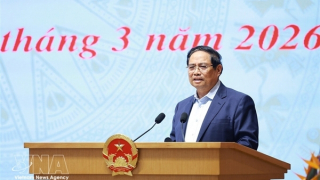
Prime Minister Pham Minh Chinh on March 28 said strategic technologies must tackle Vietnam’s practical challenges, while chairing a meeting of the Government’s Steering Committee for science and technology, innovation, digital transformation, and Project 06.
Ho Chi Minh City is stepping up efforts to attract investment from global leading groups and companies in the fields of electronic components, semiconductors and chip manufacturing as it seeks to position itself as a leading semiconductor industry hub in both the region and the world.
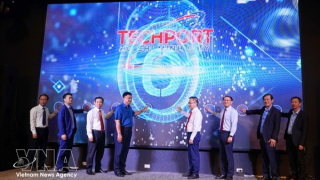
The upgraded platform represents a comprehensive shift from a simple information-sharing model to a managed online technology trading system, enabling monitoring and measurement of real transaction outcomes. It is built on three pillars, namely new tradable technology products, a modern digital platform, and an improved operational model.
AI also emerges as a key enabler for Vietnam's ambition to build financial and technology hubs. Applications can boost efficiency, automate workflows, cut costs, and sharpen data analytics, which are essential pillars of a modern financial system.
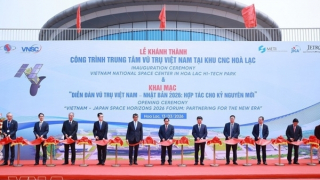
Vietnam aims by 2030 to achieve a mid-level position in space science and technology development within Southeast Asia, and after 2030 to build national capabilities to independently develop satellite technologies and apply space data to address global challenges and national security needs.
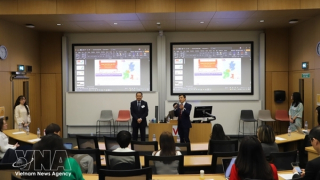
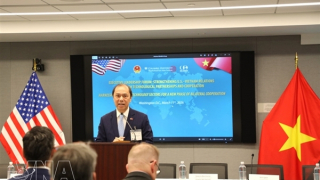
A high-level executive leadership forum focusing on strengthening Vietnam - US relations through technology cooperation was jointly held in Washington D.C. on March 11 by the Embassy of Vietnam in the US, the Weatherhead East Asian Institute of Columbia University, and the US -ASEAN Business Council (USABC).
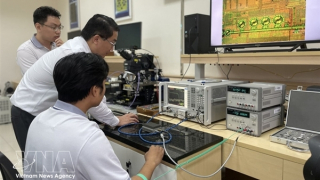
Vietnam is emerging as an important link in the global semiconductor value chain, particularly in chip packaging and testing, as the country continues to lay key foundations for developing its semiconductor industry, Deputy Prime Minister Nguyen Chi Dung has stated.
As the digital economy and knowledge-based sectors expand, institutions must evolve accordingly, regulating not only traditional economic relationships but also new resources such as data and intellectual capital.
While many countries are still drafting policy blueprints or issuing non-binding guidance, Vietnam has moved ahead with a standalone Law on Artificial Intelligence (AI), effective from March 1, placing it among a select group of nations to adopt dedicated AI legislation at the parliamentary level.